One of the quiet costs of modern life is not measured in dollars, but in attention, autonomy, and privacy. Increasingly, businesses pressure customers to install their mobile apps—not to improve service, but to track behavior, monetize data, and drive additional sales. From retailers to utilities, gyms to restaurants, the default assumption is no longer “serve the customer,” but “instrument the customer.”
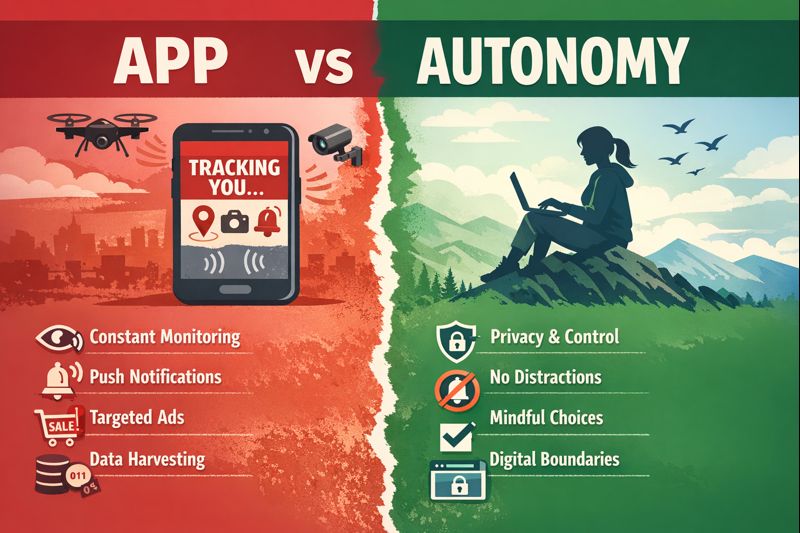
This runs directly counter to the Thrive on Less philosophy.
The App Is the Product—and You Are the Data
When a business insists that “everything works better in the app,” it is often signaling a strategic shift:
- Persistent data collection (location, device identifiers, usage patterns)
- Behavioral profiling to predict purchases and trigger nudges
- Push notifications engineered to manufacture urgency
- Cross-selling and upselling based on inferred habits, not stated needs
In many cases, the app delivers no meaningful functionality that could not be provided via a website, email, or paper receipt. The real value lies in continuous surveillance.
The Hidden Cost: Cognitive and Behavioral Drift
Beyond privacy, there is a subtler harm. Apps are designed to shape behavior:
- You open your phone for one task and are diverted into promotions.
- Discounts are conditioned on “engagement,” training you to check in.
- Loyalty programs reward frequency, not necessity.
Over time, this creates consumption drift—spending more, thinking less, and surrendering control in small, almost invisible increments.
Thriving on less requires resisting systems that profit from your distraction.
“Optional” Apps That Aren’t Optional
A growing pattern is soft coercion:
- “Install the app to access your receipt.”
- “Install the app to manage your account.”
- “Install the app to get support.”
Choice becomes nominal. Convenience is used as leverage. The business saves operational costs while transferring friction—and surveillance—to the customer.
A Thrive on Less Response: Practical Boundaries
You do not need to reject technology to live intentionally. You need boundaries.
1. Default to the Web
If a service works in a browser, use it there. Browsers offer stronger controls, isolation, and easier deletion than apps.
2. Say No to Convenience Traps
If an app exists primarily to send notifications or promotions, decline it. True convenience should reduce friction, not increase temptation.
3. Minimize Permissions
When an app is unavoidable:
- Disable location unless essential
- Turn off background activity
- Block notifications entirely
4. Separate Devices, If Necessary
For critical services that demand apps, consider isolating them on a secondary device with no personal data, contacts, or payment methods.
The Deeper Issue: Who Controls the Relationship?
Historically, a business–customer relationship was transactional and finite. Today, apps seek to make it continuous and asymmetrical—the business observes; the customer reacts.
Thrive on Less restores symmetry:
- You decide when to engage.
- You decide what data is shared.
- You decide what you truly need.
Final Thought
An app that tracks you is not neutral. It reflects a business model that treats attention as inventory and privacy as expendable.
Thriving on less means recognizing that not every “free” app is worth its price, and that dignity, focus, and restraint are forms of wealth no company should be allowed to extract.
 Thrive on Less
Leave a comment