From Protectors to Spectators
For most of human history, one expectation was clear and largely unquestioned: when danger arose, men stepped forward. Whether it was protecting family, neighbors, the weak, or even strangers, men were socially conditioned—and morally expected—to intervene. Protection was not merely a role; it was a duty tied to responsibility, courage, and accountability.
Today, that instinct still exists. Yet it is increasingly suppressed—not by fear alone, but by law, liability, and a system that often punishes intervention more harshly than inaction.
Modern society has created a paradox: men are still expected to protect, yet legally discouraged from doing so.
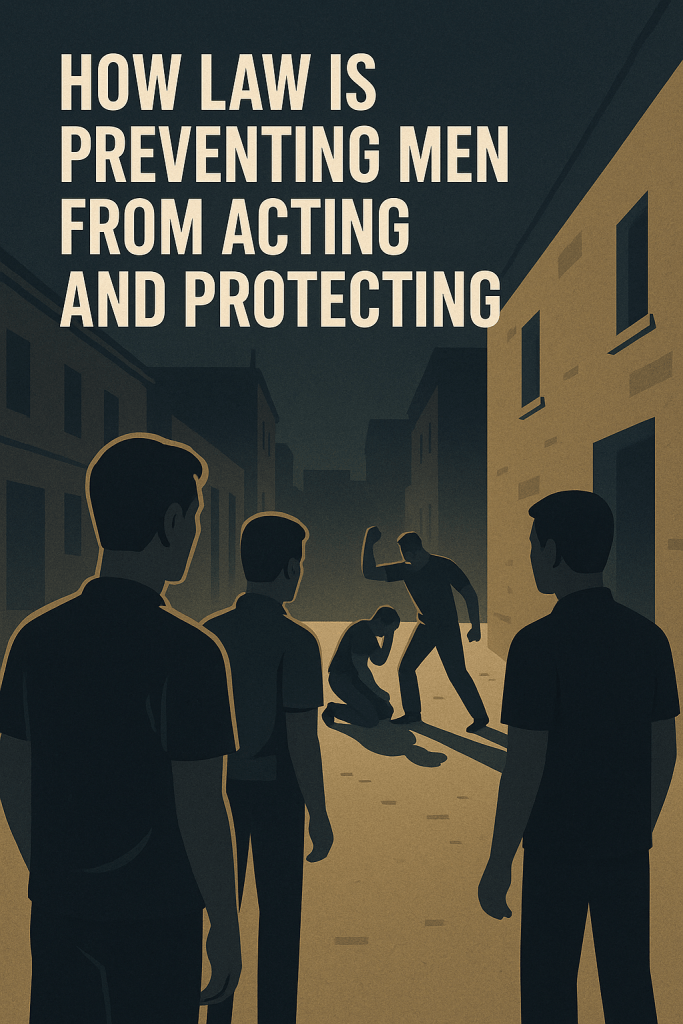
When Helping Becomes a Legal Risk
In recent decades, a disturbing pattern has emerged. Individuals who attempt to help—breaking up fights, intervening in domestic disputes, stopping theft, or assisting someone in distress—often find themselves sued, arrested, or criminally charged.
What was once considered bravery is now reframed as “assault,” “interference,” or “vigilantism.”
Good intentions are no longer sufficient. Even successful intervention can result in:
- Civil lawsuits for injury or emotional distress
- Criminal charges for excessive force
- Job loss or reputational damage
- Mandatory court appearances and legal expenses
The message is subtle but clear: intervene at your own risk.
As a result, many men are learning the same painful lesson—not through ideology, but through consequence.
The Criminalization of Presence
Even witnessing an incident is no longer neutral.
Being present often means being questioned, detained, or compelled to testify. Cooperation with authorities, while legally expected, can expose witnesses to further scrutiny, misinterpretation, or suspicion. In some cases, witnesses themselves are arrested “until facts are clarified.”
This creates a chilling effect:
- Step in, and you may be charged
- Stay nearby, and you may be implicated
- Walk away, and you are safe
Over time, rational self-preservation overrides moral instinct.
The safest position in modern society is no longer courage—it is distance.
“Mind Your Own Business” as a Social Commandment
The dominant message today is not compassion, duty, or responsibility. It is simple and repeated everywhere:
“Mind your own business.”
This is not wisdom—it is social conditioning.
A society that discourages intervention does not eliminate violence or injustice; it merely ensures that it happens without resistance. When good men stand back, wrongdoing does not disappear—it proceeds uninterrupted.
The transformation is profound:
- Communities become fragmented
- Trust erodes
- Accountability vanishes
- Evil learns there will be no resistance
We have replaced collective responsibility with legal insulation.
The Moral Cost of Legal Overreach
Law exists to protect order, not to paralyze conscience. When legal systems punish moral action more severely than moral indifference, they do not create justice—they create fear.
Men are not withdrawing because they lack courage.
They are withdrawing because the system has taught them that courage is expensive.
This has long-term consequences:
- Children grow up without visible protectors
- Women and the vulnerable lose informal safeguards
- Communities rely exclusively on institutions that arrive after harm occurs
Law enforcement becomes the sole responder, while society itself becomes passive.
A Society That Watches Itself Collapse
A culture of spectatorship is not neutral—it is dangerous.
When no one intervenes:
- Violence escalates
- Abuse persists
- Crime becomes opportunistic
- Moral boundaries dissolve
The tragedy is not only that men are restrained from acting—it is that society has normalized restraint as virtue and framed protection as liability.
We are witnessing a shift from “Do what is right” to “Do what is safe.”
Those are not the same.
The Question We Must Ask
The issue is not whether laws are necessary—they are.
The issue is whether laws have replaced moral judgment instead of supporting it.
A society that punishes protection will eventually lack protectors.
A society that discourages responsibility will eventually collapse under irresponsibility.
At some point, we must ask:
- Who benefits when good men do nothing?
- What kind of future is built on fear of helping?
- Can a society survive when conscience is subordinate to liability?
Conclusion: The Silent Loss
The greatest loss is not legal—it is moral.
When men are trained to look away, society loses more than intervention. It loses courage, solidarity, and the invisible bonds that once held communities together.
The saddest reality of modern society is not that danger exists.
It is that we have taught ourselves to watch it happen.
And call that progress.


Leave a comment