The Uncomfortable Truth of Existence
There is a hard truth woven into the fabric of life on Earth—one we often avoid because it unsettles us.
To live, something else must die.
Every ecosystem operates on this principle. One species survives at the expense of another. Predators consume prey. Plants compete for light and nutrients. Even at the microscopic level, life feeds on life. Survival is not neutral; it is competitive, violent, and relentless.
This reality raises a profound and disturbing question:
How can a good God exist in a world where life is sustained through destruction?
For many, this is where faith begins to fracture.
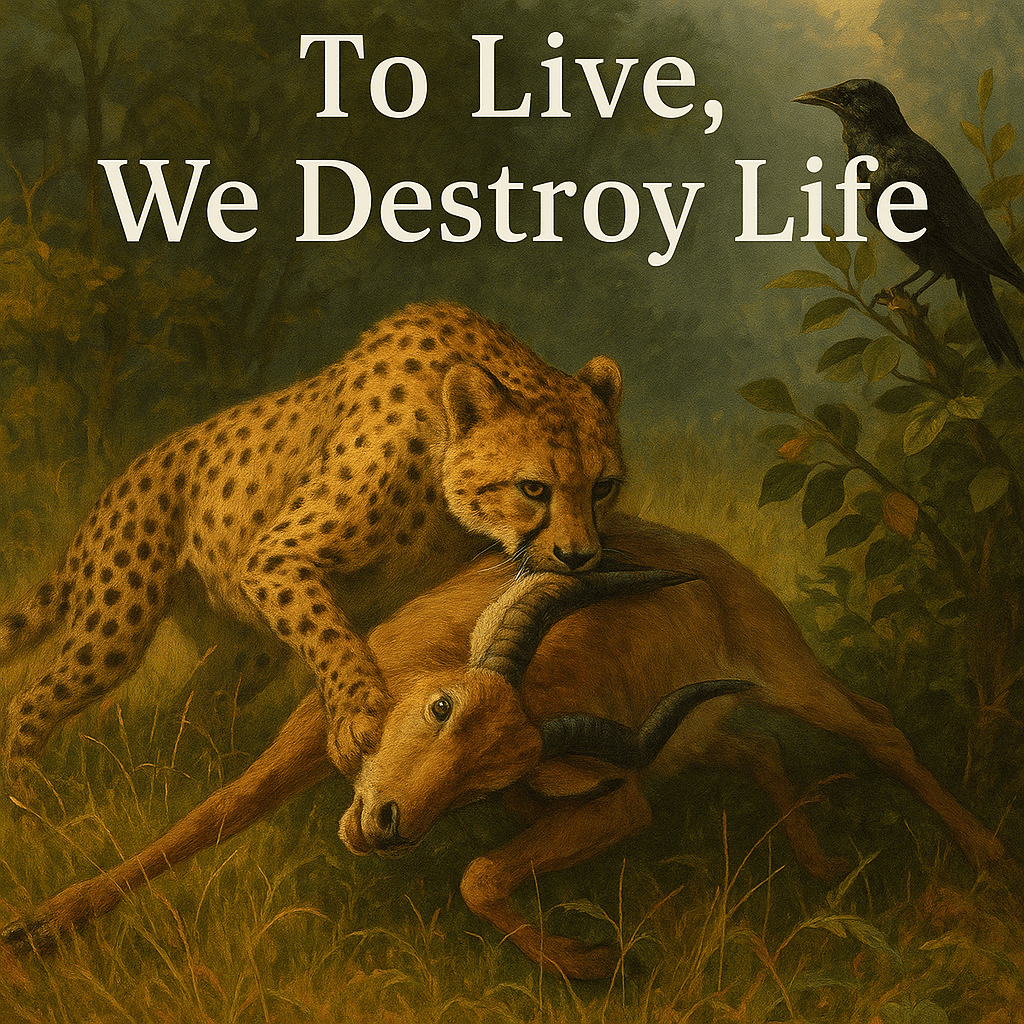
The Pattern No One Escapes
There is no life form exempt from this system.
- Animals kill to eat
- Humans kill animals and plants to survive
- Ecosystems collapse so others may rise
- Evolution—if observed purely as process—is built on extinction
Even human progress follows the same pattern:
- One civilization replaces another
- One economy grows while another collapses
- One group thrives while another is displaced
Life on this planet advances through loss.
If creation reflects its Creator, then what does this say about God?
Why This Reality Makes God Difficult to See
We are often told that nature reveals God’s goodness. Yet nature also reveals:
- Cruelty without mercy
- Death without justice
- Suffering without explanation
A deer eaten alive does not experience meaning.
A species driven to extinction does not receive redemption.
If this system is God’s original design, then God appears distant—or worse, indifferent.
This is where many abandon faith, not out of rebellion, but out of honesty.
A Crucial Distinction: Creation vs. Fallen Creation
Christian theology makes a claim that is often ignored in modern discussions:
The world we observe is not the world as it was created to be.
Scripture teaches that creation itself is fallen.
“Creation was subjected to frustration, not by its own choice…” (Romans 8:20)
Death, decay, and domination are not described as God’s ideal—but as consequences of a fractured order.
The survival-of-the-fittest world we inhabit is not the final expression of God’s will. It is the current condition of a broken creation.
Death Was Not the Original Endgame
In Genesis, life begins without death being central. Scripture does not celebrate predation or domination. Those realities emerge after rebellion fractures harmony.
The Bible presents death not as a neutral mechanism, but as an enemy:
“The last enemy to be destroyed is death.” (1 Corinthians 15:26)
If death were God’s intended design, it would not be treated as something to be conquered.
The presence of death does not reveal God’s heart—it reveals the depth of the rupture between creation and its Creator.
Humanity’s Role in the Cycle of Destruction
Humans are not observers of this system—we are amplifiers of it.
Unlike animals, humans destroy not only to survive, but to:
- Accumulate
- Dominate
- Exploit
- Control
We strip ecosystems beyond necessity. We exhaust land, oceans, and air. We justify destruction as progress.
Scripture calls humanity a steward, not a parasite. Yet we behave as though the Earth exists solely to be consumed.
This is not evolution alone—it is moral failure.
Where God Is Found in This Broken Design
God is not revealed in the brutality of survival.
God is revealed in His response to it.
Rather than remaining distant, Scripture presents a God who enters the system He condemns.
Christ does not arrive as a predator at the top of the food chain.
He arrives as prey.
He is consumed by violence rather than wielding it.
He absorbs destruction rather than inflicting it.
The cross is God’s indictment of the system, not its endorsement.
Redemption Is the End of the Cycle, Not Its Justification
Christian hope is not rooted in explaining why the world is brutal.
It is rooted in the promise that brutality will not have the final word.
Scripture points toward:
- A restored creation
- A world without predation
- A kingdom where death no longer governs life
“There will be no more death or mourning or crying or pain.” (Revelation 21:4)
God does not justify the cycle of destruction.
He promises to end it.
Why This Matters for How We Live Now
If this world is broken, then survival alone cannot be our moral compass.
To thrive on God means:
- Resisting unnecessary destruction
- Choosing stewardship over exploitation
- Valuing life beyond utility
- Refusing to worship progress at the cost of creation
We are called not to mirror the brutality of the system, but to point beyond it.
Conclusion: God Is Not in the System—He Is the Answer to It
Yes, life on Earth survives by destroying life.
That truth is undeniable.
But Christianity does not claim this is good.
It claims this is temporary.
God is not glorified by the system of survival.
He is glorified by His promise to redeem creation from it.
The question is not whether God exists in a world built on death.
The question is whether there is hope beyond it.
Without God, destruction is all there is.
With God, destruction is not the end.
That is where faith begins—not in denial of reality, but in hope for its restoration.


Leave a comment