Why This Question Matters
Few topics generate as much tension among believers as the question of evolution. For some, accepting evolution feels like denying Scripture. For others, rejecting evolution feels like denying observable reality. As a result, many Christians feel forced into a false choice: faith or reason, God or science.
But Scripture never demands intellectual fear, and truth does not contradict itself.
The real issue is not evolution versus the Bible—it is confusion about what each is meant to explain.
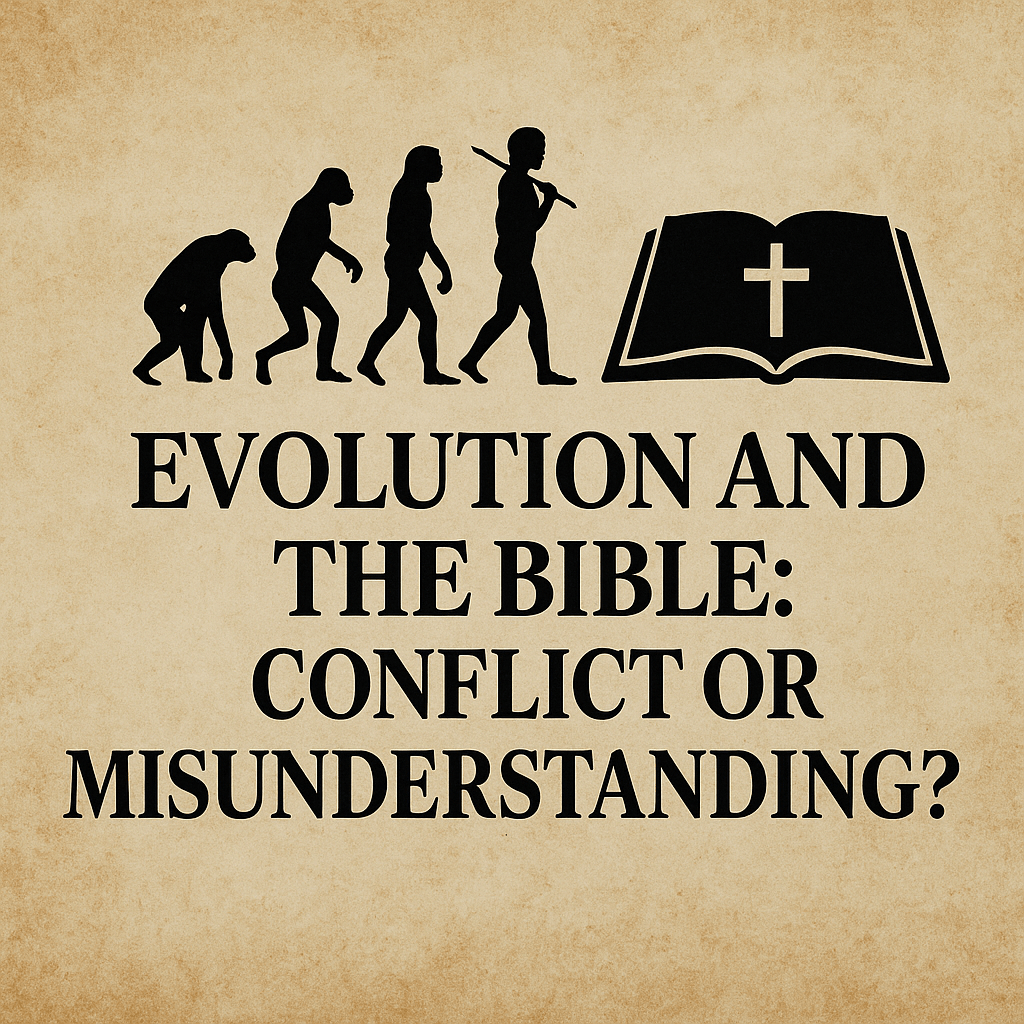
Two Different Questions: How and Why
Science and Scripture answer fundamentally different questions.
Science asks:
- How biological processes occur
- What mechanisms shape the physical world
The Bible answers:
- Who created everything
- Why creation exists
- What humanity’s purpose is
- Why moral law, sin, and redemption exist
When science is forced to explain meaning, it becomes ideology.
When Scripture is forced to function as a modern biology textbook, it is misused.
Conflict arises not from truth—but from category error.
Genesis Was Not Written as a Science Manual
Genesis was written to proclaim the authority of God, not to outline molecular biology.
Its central claims are theological:
- God alone is Creator
- Creation is intentional and ordered
- Humanity is uniquely made in God’s image
- Sin enters history through human rebellion
The ancient audience did not think in terms of DNA, geological ages, or evolutionary timelines. Genesis communicates eternal truths, often using literary and symbolic language to do so.
A non-literal reading of how God created does not weaken Scripture—it often honors its intent.
How Christians Approach Creation
Throughout history, faithful believers have held different views on creation while affirming the same core doctrines.
1. Young Earth Creation
Creation in six literal days; Earth is young.
2. Old Earth Creation
Creation unfolds over long epochs; “days” represent extended periods.
3. Theistic Evolution (Evolutionary Creation)
God sovereignly uses evolutionary processes as a means of creation.
What unites orthodox Christianity is not the method, but the Author.
In every faithful model:
- God is intentional
- God is sovereign
- God is not replaced by chance
“Random” Does Not Mean Godless
One of the greatest misunderstandings is the word random.
In science, randomness means unpredictable to human observation.
In theology, nothing is outside God’s sovereignty.
Scripture affirms this repeatedly:
“The lot is cast into the lap, but its every decision is from the Lord.” (Proverbs 16:33)
What appears random to us is never random to God.
Evolutionary mechanisms, if real, would still operate under divine authority—not outside it.
Humanity, Adam, and the Image of God
The most sensitive issue is humanity’s origin.
The Bible does not ground human value in biology but in relationship:
- Moral awareness
- Spiritual capacity
- Accountability before God
The image of God is not DNA—it is calling, responsibility, and communion.
Adam represents humanity’s entrance into covenant relationship with God—and humanity’s fall into sin. Any faithful interpretation must preserve:
- The reality of sin
- Humanity’s moral responsibility
- The necessity of redemption
Scripture is clear:
“As in Adam all die, so in Christ all will be made alive.” (1 Corinthians 15:22)
Christ, not biological origins, is the center of Christian faith.
What Evolution Cannot Explain
Even if evolution explains biological change, it cannot explain:
- Why existence exists at all
- Why moral law exists
- Why conscience condemns us
- Why humans seek meaning and transcendence
- Why evil is universally recognized as evil
Science describes mechanisms.
Scripture reveals purpose.
No theory of evolution explains the human soul.
The Real Danger: Two Extremes
Two errors distort this discussion.
Scientism claims science is the only source of truth.
Anti-intellectual literalism treats every biblical text as technical description.
Both diminish truth.
Christian faith has always affirmed that God is the author of both nature and revelation. Truth discovered honestly will not contradict truth revealed faithfully.
Christ Remains the Foundation
Christianity does not stand on a timeline.
It stands on a tomb that is empty.
Regardless of how God created:
- Sin is real
- Grace is necessary
- Redemption is only through Christ
Genesis tells us who made us.
The Gospel tells us why we need salvation.
That is where faith rests.
Conclusion: God Is Not Threatened by Inquiry
The Bible does not fear science.
God does not fear investigation.
Truth does not fear questions.
What Scripture demands is not blind rejection of observation, but humble submission to God as Creator, Sustainer, and Redeemer.
Evolution may describe processes.
Only God gives life meaning.
To thrive on God is to trust that all truth ultimately leads back to Him.


Leave a comment