In Jewish tradition, Lilith is remembered as the woman who refused to submit, who walked away from covenant and duty to chase her own desires. Whether taken as myth, symbol, or warning, she has become a mirror for a troubling spirit we see in today’s world: the rise of self over sacrifice, desire over duty, and pride over love.
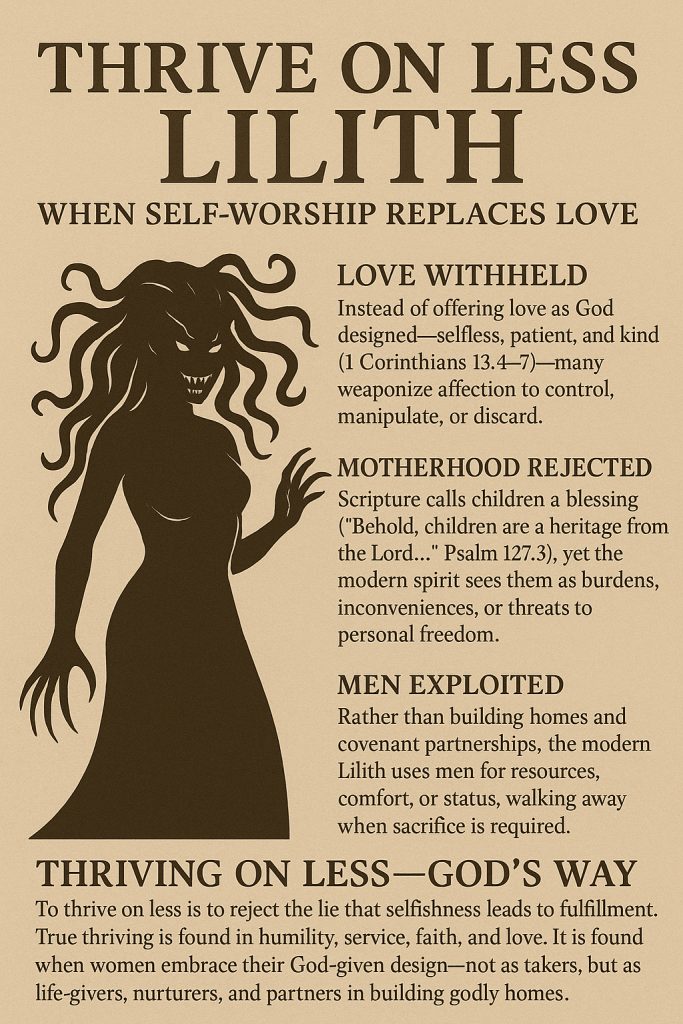
Today’s “modern Lilith” is not a myth but a mindset. It is the spirit of self-worship that teaches women to reject their God-given role, to turn away from love, to see children as obstacles, and to view men not as partners but as tools.
📖 The Bible warns us of this:
- “But know this, that in the last days perilous times will come: For men will be lovers of themselves, lovers of money… unloving, unforgiving…” (2 Timothy 3:1–3).
- “For where you have envy and selfish ambition, there you find disorder and every evil practice.” (James 3:16).
The Traits of the Modern Lilith
- Love Withheld: Instead of offering love as God designed—selfless, patient, and kind (1 Corinthians 13:4–7)—many weaponize affection to control, manipulate, or discard.
- Motherhood Rejected: Scripture calls children a blessing (“Behold, children are a heritage from the Lord…” Psalm 127:3), yet the modern spirit sees them as burdens, inconveniences, or threats to personal freedom.
- Men Exploited: Rather than building homes and covenant partnerships, the modern Lilith uses men for resources, comfort, or status, walking away when sacrifice is required.
- Self Enthroned: Instead of bowing before God, the modern Lilith bows to the mirror. Pride becomes her altar, and vanity her worship.
Thriving on Less—God’s Way
To thrive on less is to reject the lie that selfishness leads to fulfillment. True thriving is found in humility, service, faith, and love. It is found when women embrace their God-given design—not as takers, but as life-givers, nurturers, and partners in building godly homes.
Lilith’s path is rebellion, pride, and emptiness. But Christ offers another way:
- “Whoever finds their life will lose it, and whoever loses their life for my sake will find it.” (Matthew 10:39)
- “Do nothing out of selfish ambition or vain conceit. Rather, in humility value others above yourselves.” (Philippians 2:3).
The call to thrive on less is not a call to emptiness but to fullness—fullness in God’s love, in family, and in the eternal joy that self-worship can never provide.
 Thrive on Less
Leave a comment